
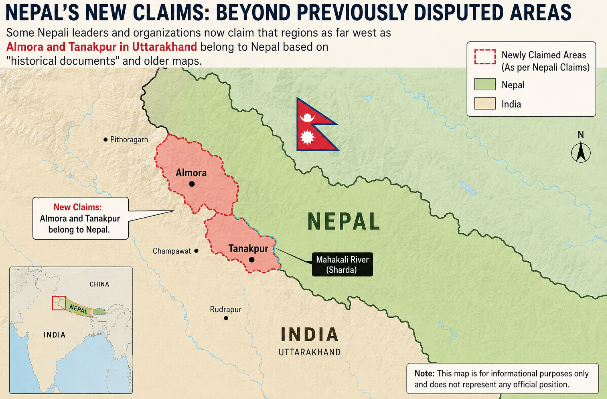
India-Nepal Border Dispute Revived: Nepal PM’s Claims Spark Tensions Over Almora and Tanakpur Areas
Quick Summary Nepal Prime Minister Balendra Shah recently reignited the two-century-old India-Nepal border dispute by stating in parliament that Nepal has also encroached into Indian territory in several regions, including areas near Almora and Tanakpur in Uttarakhand. India has strongly responded, calling the territorial claims unjustified and emphasizing that the matter must be resolved through bilateral dialogue only.
What Triggered the Recent Controversy?
On May 31, 2026, Nepal Prime Minister Balendra Shah made remarks in parliament during a discussion on border issues. He stated that not only India encroached on Nepali land, but Nepal has also intruded into Indian territory in several regions. This statement immediately drew attention to the long-standing border dispute between the two neighboring countries.
Following public backlash both within Nepal and from India, Nepal’s Foreign Ministry clarified that the Prime Minister was referring to cross-border occupation and encroachments on “no-man’s land,” not formal territorial claims over established Indian territories.Almora and Tanakpur Encroachment Issues the Almora and Tanakpur areas in Uttarakhand’s Champawat district have seen local-level encroachment disputes:
Almora Area:
In the Khatima area and adjoining Champawat district, farmers from both India and Nepal have cultivated land in the disputed “no-man’s land” Zone both sides have set up temporary huts and farming Structures a joint survey has been planned by Indian and Nepalese military and administrative officials to demarcate the boundary and remove unauthorized Encroachments approximately 269 border pillars demarcating the Indo-Nepal border in southeast Uttarakhand have been found missing, spanning from pillar 700 in Palia Kalan, India, to pillar 811 in Brahmadev,
Nepal tanakpur Area:
Nepalese citizens planted saplings and created barricades along approximately 200 meters near Border Pillar No. 811The Nepalese Armed Border Force and Champawat Police from India arrived at the site to address the situation Nepalese officials had previously assured that plantation drives in the no-man’s land near Tanakpur would be stopped, but the situation remains Unresolved district officials from both countries have held talks to address the encroachment issue
The Core Border Dispute: Kalapani, Lipulekh, and Limpiyadhura
While Almora and Tanakpur involve local encroachment issues, the actual territorial dispute centers on three key areas:
Nepal’s Position:
Nepal claims that Kalapani, Lipulekh, and Limpiyadhura territories belong to Nepal The claim is based on the belief that the Kali River’s source begins at Limpiyadhura, which would place these territories on the Nepalese Side in November 2025, Nepal unveiled a new 100-rupee note featuring a revised national map that includes these disputed areas
India’s Position:
India maintains that Kalapani, Lipulekh, and Limpiyadhura are part of Uttarakhand state India’s position is based on the Kali River’s source beginning at Lipulekh, placing these territories on the Indian side The Indian government has stated that Nepal’s territorial claims are “neither justified nor based on historical facts and evidence”India described Nepal’s new map as an “artificial enlargement of territorial claims, not based on historical facts”
India’s Official Response the Ministry of External Affairs (MEA) of India responded firmly to Nepal’s remarks:
MEA Spokesperson Randhir Jaiswal stated that boundary-related matters between India and Nepal are strictly Bilateral india firmly ruled out any role for third parties, including China, the United Kingdom, or the United States, in resolving the Dispute jaiswal emphasized that existing mechanisms between the two neighbours are sufficient to address border Issues according to official data, approximately 98% of the India-Nepal boundary has already been demarcated, with unresolved segments primarily due to the shifting course of the Gandak river
Recent Developments and Resolution Mechanisms several significant developments have occurred in recent months:
1.Diplomatic Exchange:
Nepal officially sent a diplomatic note to India regarding encroachment at Lipulekh, and India responded to the Complaint
2.inside Nepal Backlash:
Prime Minister Shah’s acknowledgment that Nepal also encroached Indian land triggered significant backlash within Nepal Itself
3.resolution Agreement:
Both countries agreed to use historians, surveyors, and border experts for technical consultation to resolve the
4.Dispute joint Survey Plans:
India and Nepal have planned joint military and administrative surveys to address encroachments along the Uttarakhand border
Strategic Significance
The Kalapani-Limpiyadhura-Lipulekh tri-junction represents a strategically critical region in western Uttarakhand. This area is significant for:
- Border security and defense considerations
- Control over mountain passes and trade routes
- Water resource management related to the Kali River
- Regional stability between two important South Asian nations
Key Facts About the India-Nepal Border
- The border dispute dates back to the 1816 Treaty of Sugauli
- The total India-Nepal border spans approximately 1,850 kilometers
- The dispute involves four main areas: Kalapani, Lipulekh, Limpiyadhura, and Susta
- Local encroachment issues occur periodically along various segments of the border
- Both countries maintain open border policies for their citizens under the 1950 Indo-Nepal Treaty of Peace and Friendship
Conclusion
the recent revival of the India-Nepal border dispute highlights the ongoing challenges in border demarcation between the two neighboring countries. While the Almora and Tanakpur issues involve local encroachments on disputed no-man’s land, the core territorial dispute remains centered on Kalapani, Lipulekh, and Limpiyadhura. India has consistently maintained that the matter should be resolved through bilateral dialogue without third-party intervention, emphasizing the existence of adequate mechanisms between the two nations to address border issues.Both countries have agreed to engage technical experts including historians and surveyors to work toward a resolution, reflecting a commitment to resolving the dispute through diplomatic means while maintaining the strategic relationship between India and Nepal.
This article contains factual information about the India-Nepal border dispute based on publicly available news reports and official statements from both governments