
Chronic Fatigue Syndrome: What Science Now Tells Us7 min read
Chronic Fatigue Syndrome: What Science Now Tells Us
New research confirms ME/CFS has measurable, physical roots in the brain, immune system, and gut — and points toward real treatment possibilities.
Myalgic encephalomyelitis/chronic fatigue syndrome (ME/CFS) has long been misunderstood. For decades, many dismissed it as a psychological condition — something patients imagined or exaggerated. A growing body of scientific evidence is decisively changing that view.
A landmark study from the National Institutes of Health (NIH), published in Nature Communications in February 2024, conducted some of the most thorough biological testing ever performed on people with ME/CFS. The findings reinforce what thousands of earlier studies have suggested: this illness has real, measurable, physical causes spread across multiple systems of the body.
What Is ME/CFS?
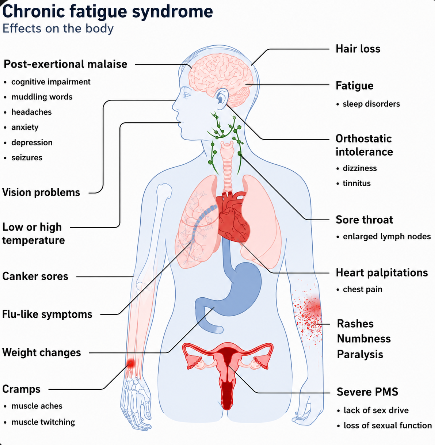
ME/CFS is defined by a cluster of debilitating symptoms: overwhelming fatigue that does not improve with rest, difficulty thinking and concentrating (often called “brain fog”), and a significant worsening of symptoms following even mild physical or mental effort. This last symptom — known as post-exertional malaise — is one of the most disabling features of the illness.
Many patients with ME/CFS were previously healthy individuals who fell ill after what appeared to be a routine infection — a sore throat, muscle aches, low energy. Unlike most infections, however, they never fully recovered. Some are left so debilitated that they become bedridden or homebound for years.
“These abnormalities have been reported in thousands of published studies over the past 40 years — yet ME/CFS continues to be one of the most underfunded and misunderstood illnesses in medicine.”
About the NIH Study
The NIH study enrolled participants who developed ME/CFS after an infection. All participants spent a full week at the NIH campus, undergoing a wide battery of tests each day — brain imaging, immune profiling, spinal fluid analysis, and more. A healthy control group of similar age and sex underwent the same testing for comparison.
The breadth of this testing is what sets this study apart from much of the earlier research. Rather than focusing on a single system of the body, the NIH team looked broadly and systematically for biological differences between ME/CFS patients and healthy individuals.
Three Key Findings
Finding One — Immune System
The immune systems of ME/CFS patients showed signs of prolonged, chronic activation — as though the body were still fighting an infection that had never fully been cleared. Over time, this relentless state of immune mobilization causes immune cells to become exhausted, reducing their ability to function effectively. The NIH team noted that a class of drugs called immune checkpoint inhibitors — already used in cancer treatment — may hold potential for reinvigorating these worn-out immune cells.
Finding Two — Brain Activity
Brain scans revealed abnormal activity in a specific region called the right temporal-parietal area — a part of the brain involved in perceiving fatigue and motivating effort. In healthy individuals, this area becomes more active during physical or mental exertion. In ME/CFS patients, its response was significantly blunted. The researchers concluded that this abnormality makes any form of effort feel far more demanding than it should — like trying to swim against a current.
Finding Three — Spinal Fluid Chemistry
Analysis of cerebrospinal fluid — which surrounds the brain and reflects its chemical environment — showed measurable differences in neurotransmitter levels and markers of inflammation in ME/CFS patients compared to healthy controls. This finding adds to evidence that the brain chemistry of ME/CFS patients is objectively altered, not merely subjectively perceived.
Other Notable Observations
The study also uncovered significant biological differences between men and women with ME/CFS — an important finding that researchers say warrants further investigation to understand its causes and implications.
Crucially, the study found no difference in the rate of psychiatric disorders — either current or historical — between ME/CFS patients and healthy controls. This directly challenges the long-held assumption that ME/CFS is a psychological condition, and confirms that its symptoms cannot be attributed to mental health causes.
What This Means for Treatment
The NIH team concluded that ME/CFS is primarily a disorder of the brain, likely triggered by chronic immune activation and changes in the gut microbiome. This understanding opens practical avenues for treatment. If immune exhaustion is a driver, immune checkpoint inhibitors may help. If gut microbiome disruption plays a role, targeted interventions there may also offer relief.
While there is still no approved cure for ME/CFS, research like this is essential groundwork. Identifying what is actually going wrong in the body is the first and necessary step toward developing therapies that can correct it.
Study Limitations to Keep in Mind
The study included only 17 people with ME/CFS and 21 healthy controls — a small sample, partly because enrollment had to be halted due to the COVID-19 pandemic. A small sample size limits statistical power, meaning some real abnormalities may have gone undetected. Larger follow-up studies are needed to confirm and expand on these findings.
The Bottom Line
ME/CFS is a real, biologically grounded illness. It affects millions of people and causes profound disability. This NIH study adds to decades of evidence showing measurable abnormalities in the brains, immune systems, energy metabolism, blood vessels, and gut bacteria of those who suffer from it.
The science is gradually catching up to the suffering. And with each rigorous study, the path toward understanding — and eventually treating — this devastating condition becomes a little clearer.
Komaroff, A.L. (2024). Is chronic fatigue syndrome all in your brain? Harvard Health Publishing, Harvard Medical School. Retrieved from:
https://www.health.harvard.edu/diseases-and-conditions/is-chronic-fatigue-syndrome-all-in-your-brain
Original NIH study: Walitt, B. et al. (2024). Deep phenotyping of post-infectious myalgic encephalomyelitis/chronic fatigue syndrome. Nature Communications.
This article is written for general informational purposes only and does not constitute medical advice. Always consult a qualified healthcare professional for personal medical guidance.