Trump Unveils Phased Tariff Plan on Generic Drugs — Zero Tariffs for 2 Years, Then 100% and Eventually 200%
🔴 BREAKING · WASHINGTON · JULY 2026
Trump Unveils Phased Tariff Plan on Generic Drugs — Zero Tariffs for 2 Years, Then 100% and Eventually 200%
Section 232, Trade Expansion Act · Effective August 1, 2026
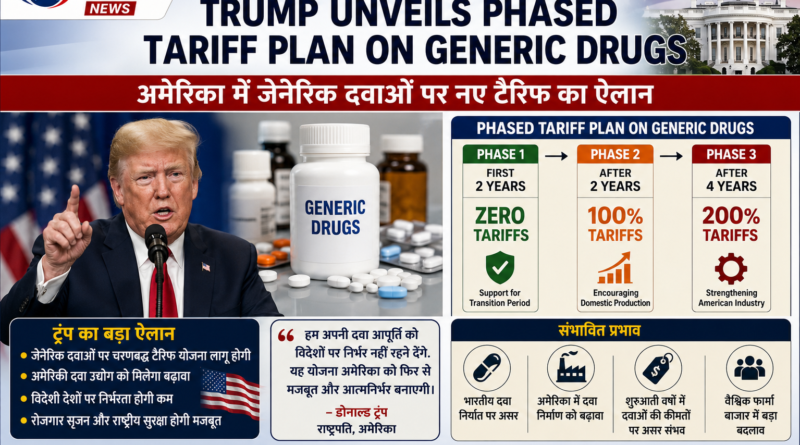
President Donald Trump has announced a multi-year tariff roadmap for generic medicines imported into the United States, giving drugmakers a two-year window to relocate manufacturing before duties climb sharply. The move marks the most significant escalation yet in Washington’s push to reshore pharmaceutical production, and carries major implications for countries like India that supply the bulk of America’s generic drug needs.
|
0% Tariff
For 2 years starting
August 1, 2026 |
100% Tariff
For 1 year starting
August 2028 |
200% Tariff
Indefinitely, starting
August 2029 |
What Exactly Did Trump Announce?
In a post on Truth Social on Tuesday, Trump said all generic drugs imported into the US would continue to face a 0% tariff for a two-year period beginning August 1, 2026. After that grace period ends, the tariff will jump to 100% for one year, before rising to 200% thereafter on a permanent basis. Trump described the escalating structure as a deliberate “penalty” for companies that fail to build manufacturing plants and equipment in the US within the time given to them.
The White House confirmed the policy will be implemented under Section 232 of the Trade Expansion Act of 1962 — the same national-security trade authority Trump has used for earlier tariff actions on steel, aluminum, and branded pharmaceuticals. Crucially, Trump clarified that the existing policy on patented, branded, or innovative drugs will remain unchanged, meaning this new schedule applies specifically to the generic drug category.
“This is done in order to reshore Generic Pharmaceutical Production into America, with a penalty to those companies that decide not to build plant and equipment within the stated period of time given to them.”
— Donald Trump, U.S. President, via Truth Social
Why Generic Drugs Matter So Much
Generic medicines are not a niche category — according to the US Food and Drug Administration, they account for more than 90% of all medicines sold in the United States. That makes this announcement far more consequential for everyday American healthcare costs than the earlier tariffs on branded pharmaceuticals, which affect a smaller, higher-margin slice of the market. Trump has separately been pressuring drugmakers through his “most-favored-nation” drug pricing policy, aimed at bringing US drug prices closer to what people pay in other high-income countries.
How We Got Here — The Broader Pharma Tariff Timeline
📅 Key Developments
💊 April 2, 2026 — Trump imposes a 100% Section 232 tariff on patented and branded pharmaceutical products and ingredients, while exempting generics, biosimilars, and their ingredients
⏳ Grace periods set — Large drugmakers given 120 days, smaller firms relying on contract manufacturers given 180 days, before the 100% branded-drug tariff takes full effect
📉 Following weeks — Indian pharma stocks, including Sun Pharma, Cipla, Dr Reddy’s, and Divi’s Labs, fall between 2-4% on tariff announcements, though analysts call the reaction largely sentimental since India’s exports are mostly generics
🤝 Through the year — More than a dozen major drugmakers, including Eli Lilly, Pfizer, and Novo Nordisk, strike deals with the Trump administration to lower prices on new and existing medicines
📢 July 21, 2026 — Trump announces the phased generic drug tariff schedule: 0% for two years, then 100%, then 200%, effective August 1, 2026
Generic Drugs vs Branded Drugs — How the Two Tracks Differ
|
💊 Generic Drugs (New Policy)
✅ 0% tariff for 2 years from August 1, 2026 ✅ 100% tariff for 1 year after the grace period ✅ 200% tariff indefinitely thereafter ✅ Covers over 90% of all US medicine sales |
💉 Branded/Patented Drugs (Existing Policy)
📌 Already facing 100% tariff since October 2025/April 2026 rollout 📌 Companies “building” domestic plants can avoid the tariff 📌 Remains unchanged under the new announcement 📌 Affects a smaller, higher-margin share of the market |
What This Means for India
India is one of the world’s largest exporters of generic medicines to the US, with pharmaceutical exports to America reaching roughly $10 billion in the last fiscal year — more than a third of India’s total pharma exports. Until now, Indian generic drugmakers had largely been shielded from the tariff turmoil that hit branded pharma stocks, since their exposure is concentrated in commodity generics rather than patented products.
That shield now has an expiry date. While the two-year zero-tariff window gives companies like Sun Pharma, Cipla, Dr Reddy’s Laboratories, Lupin, and Aurobindo Pharma breathing room, the eventual 100% and 200% tariffs would be severe if they take effect as scheduled in 2028 and 2029. Industry representatives have previously noted that Indian firms primarily export generic medications to the US, meaning the long-term impact of this specific announcement could be far more consequential than the earlier branded-drug tariffs, which had a comparatively “limited” effect according to analysts.
Industry Reaction and Outlook
The Association for Accessible Medicines, which represents US generic drug manufacturers, has previously voiced concern over tariff measures affecting the sector, warning that steep duties could ultimately raise costs for American patients who rely on affordable generics for everyday prescriptions. Trump, for his part, has pointed to a wave of new pharmaceutical facility construction in the US as evidence the strategy is already working, writing that “pharmaceutical facilities are being built, at a level never seen before, all over the United States of America.”
Analysts caution that two years is a tight timeline for building and certifying new pharmaceutical manufacturing plants, which typically require significant capital investment and regulatory approval. Whether major generic producers — both domestic and international — can realistically shift production onshore before the 2028 deadline remains an open question that will shape how disruptive the tariff escalation ultimately proves to be.
📌 The Bottom Line: Trump has laid out a three-stage tariff schedule for generic drugs imported into the US: zero tariffs for two years starting August 1, 2026, followed by a 100% tariff for one year, and then a permanent 200% tariff. The plan, enacted under Section 232 authority, is designed to pressure generic drugmakers — including major Indian exporters — into building manufacturing plants on US soil, while leaving the existing tariff regime on branded and patented drugs unchanged.
Sources: Reuters · Fox Business · CNBC · U.S. News & World Report · Republic World · Tribune India · Business Standard · July 21-22, 2026.